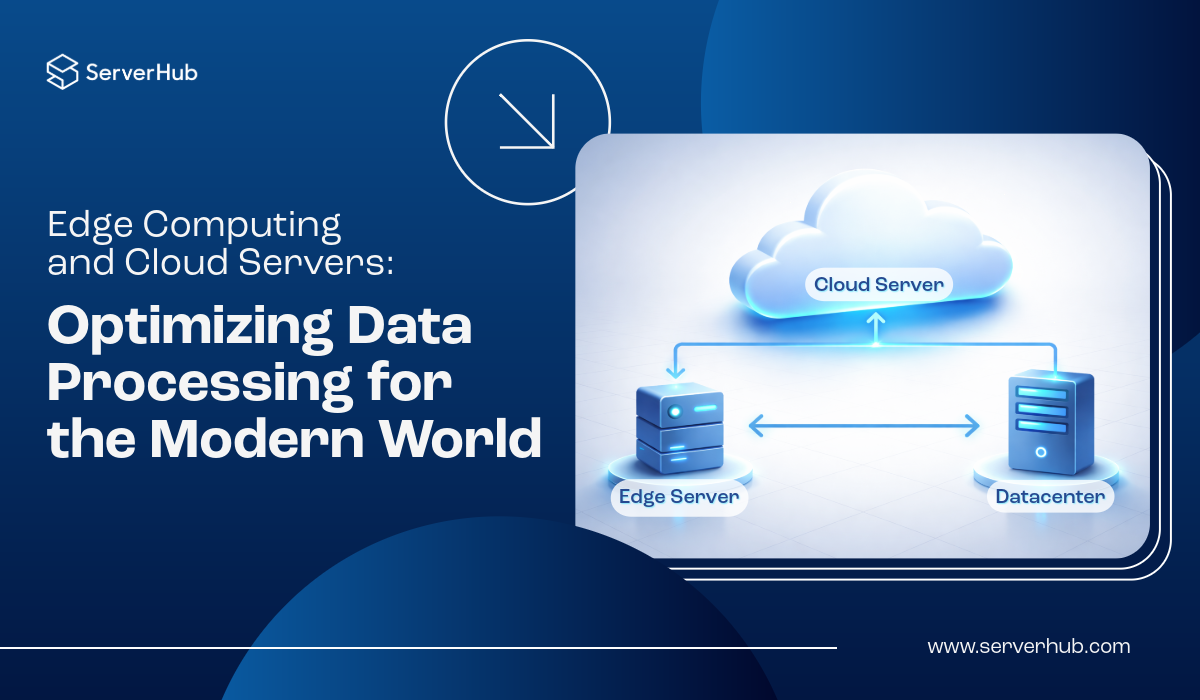
In an era defined by data deluge and the demand for instantaneous digital experiences, traditional centralized computing models are being stretched to their limits. The exponential growth of Internet of Things (IoT) devices, real-time analytics, and latency-sensitive applications has catalyzed a paradigm shift in how we process and manage information. This shift is embodied in the synergistic evolution of two powerful frameworks: edge computing and cloud servers, and centralized cloud infrastructure. Understanding this new landscape begins with defining its core components.
In this article, we’ll discuss the definitions of edge computing, edge server, and cloud servers, and the uses of edge computing and cloud servers. We’ll also tackle the relation of edge computing and cloud servers to datacenters, the benefits of moving compute resources to the end-user, and the industries that will benefit from edge servers.
What is an Edge Server?
An edge server is the physical hardware that enables edge computing. It is a compact, often ruggedized computing node deployed at the edge of the network to process data locally. These servers are designed to operate in non-traditional IT environments, withstanding variable temperatures, vibrations, and limited physical space. They run applications, perform analytics, and filter data, sending only crucial, aggregated information to the central cloud or datacenter. An edge server acts as a miniaturized, localized datacenter, providing the computational muscle at the source.
What Are Cloud Servers?
Cloud servers are virtual or physical servers hosted in large, centralized, and highly optimized datacenters operated by cloud service providers (e.g., AWS, Microsoft Azure, or Google Cloud). They are workhorses of the traditional cloud model, offering vast, scalable pools of computing power, storage, and services over the internet. Users access these resources on-demand, paying only for what they consume, without the burden of managing physical hardware. Cloud servers excel at handling massive batch processing, complex analytics on aggregated data, long-term storage, and running applications that are not latency critical.
What Are the Uses of Edge Computing?
Edge computing is indispensable for scenarios where milliseconds will matter, or bandwidth is constrained. Its major uses include:
* Autonomous Vehicles: They require instantaneous processing of sensor data (e.g., LIDAR, cameras) to navigate and avoid obstacles.
* Industrial IoT (IIoT): Enables real-time monitoring and predictive maintenance on factory equipment, detecting anomalies before failures occur.
* Smart Cities: Processes data from traffic cameras and sensors to optimize light timing, manage congestion, and improve public safety in real time.
* Telemedicine and Augmented Reality: Powers low-latency applications like remote surgery and immersive AR/VR experiences, where any delay disrupts functionality.
* Content Delivery Networks (CDNs): Cache popular media and web content at edge locations closer to users for faster streaming and browsing.
What Are Cloud Servers Used For?
Cloud servers form the backbone of modern digital business. They are ideal for:
* Big Data Analytics: Crunching petabytes of historical and aggregated data to uncover trends and train machine learning models.
* Enterprise Applications: Hosting ERP, CRM, and collaboration tools like Microsoft 365 or Salesforce.
* Website and Application Hosting: Running the core backend services for web apps, APIs, and databases.
* Disaster Recovery and Backup: Providing geographically redundant storage for business continuity.
* Development and Testing: Offering scalable, on-demand environments for software development cycles.
What Is the Relation of Edge Computing and Cloud Servers to Datacenters?
The relationship between edge computing, cloud servers, and datacenters is not about replacement, but of redefinition and collaboration. It represents a move from a purely centralized model to an intelligent, hierarchical, and distributed server network.
Centralized vs. Distributed Compute Models
For over a decade, the trend in compute models has been toward centralization in massive, hyperscale cloud datacenters. This model offers unparalleled economies of scale, simplicity, and global accessibility. However, its weakness is physics: the speed of light imposes a hard limit on latency over long distances, and network bandwidth is finite and costly.
The distributed model, championed by edge computing, addresses these limitations by decentralizing compute resources. Datacenters don't disappear; they evolve. The traditional core cloud datacenter remains. But it is now complemented by a vast, proliferating layer of micro-data centers, which are the edge servers deployed at thousands of strategic locations. The core datacenter becomes the "brain" for heavy lifting, while the edge nodes act as the fast reacting "nervous system."
How Edge and Cloud Work Together in Hybrid Architectures
The most powerful modern IT architectures are hybrid, seamlessly integrating edge and cloud resources. The following is an example of the logical data workflow of a hybrid architecture in an oil rig:
1. Immediate Processing at the Edge: An IoT sensor on an oil rig detects a vibration anomaly. Instead of sending a continuous raw data stream across a satellite link (which is slow and expensive), an edge computing cloud server on the rig processes the data in milliseconds. It determines the vibration exceeds a critical threshold and immediately triggers a safety shutdown; a decision made locally in real-time.
2. Selective Data Forwarding: The edge server then packages a summary of events such as key metrics, timestamps, and the action taken, and sends this small, valuable dataset to the central cloud.
3. Aggregation and Deep Analysis in the Cloud: In the cloud, data from thousands of edge devices across all global oil rigs is aggregated. Cloud servers run advanced machine learning models on this vast dataset, identifying deeper patterns that might predict failures weeks in advance. The cloud model is then updated.
4. Cloud-to-Edge Propagation: The improved predictive model is automatically pushed back down to all relevant edge computing cloud servers worldwide, enhancing their local intelligence for future events. This continuous feedback loop creates a self-improving, intelligent system.
What Are the Main Benefits of Moving Compute Resources Close to the End-User?
Deploying a distributed server network that places compute closer to user delivers transformative advantages that extend far beyond simple speed::
* Ultra-Low Latency: This is the most cited benefit. By processing data locally, edge systems eliminate the round-trip journey to a distant cloud. This is critical for interactive applications like gaming, financial trading, and industrial robotics, where milliseconds translate to competitive advantage, safety, and user satisfaction.
* Bandwidth Optimization and Cost Reduction: Transmitting vast volumes of raw video, sensor, or log data to the cloud consumes enormous bandwidth, incurring high costs. Edge computing filters, compresses, and analyzes this data locally, sending only actionable insights. This dramatically reduces network strain and operational expenses.
* Enhanced Reliability and Autonomy: Edge devices can operate independently during network outages. A smart factory or a retail store with edge servers can continue core operations and make critical decisions even if its connection to the central cloud is temporarily lost, ensuring business continuity and resilience.
* Improved Data Privacy and Security: Sensitive data can be processed locally at the edge, never leaving the premises. This is crucial for industries with strict data sovereignty regulations (like healthcare with HIPAA or finance with GDPR). It reduces the attack surface associated with transmitting raw data across networks.
* Scalability for Massive IoT Deployments: The cloud-alone model can become a bottleneck when managing millions of devices. Edge computing distributes the processing load, allowing the system to scale efficiently by adding more edge nodes rather than infinitely scaling a central pipeline.
Which Industries Will See the Biggest Benefits from Edge Servers?
While nearly every sector will be touched by this shift, some industries stand to gain disproportionately from the benefits of edge servers. These include:
* Manufacturing and Industrial: This is perhaps the most significant arena. Edge computing industries like manufacturing use edge servers for real-time machine vision (quality control), predictive maintenance, and coordinating autonomous robots on the assembly line. The ability to process data from thousands of sensors in real-time prevents costly downtime and optimizes production flow.
* Telecommunications (5G): 5G networks are inherently edge-native. Telecom providers are deploying edge servers at cell tower bases to enable ultra-reliable low-latency communication (URLLC) services. This unlocks applications like network slicing for enterprises, enhanced mobile broadband, and the true potential of massive IoT.
* Healthcare: From wearable patient monitors that provide real-time alerts to edge-enabled MRI machines that pre-process images, edge computing saves crucial time. It enables remote patient monitoring and tele-surgery, where latency is literally a matter of life and death, solidifying healthcare's place among critical edge computing industries.
* Retail: Smart stores use edge servers to power cashier-less checkouts (like Amazon Go), analyze in-store customer traffic patterns in real time for dynamic promotions, and manage inventory via smart shelves. Processing video feeds locally protects customer privacy and enables instant responses.
* Transportation and Logistics: Autonomous vehicles are the ultimate edge devices. For semi-autonomous and smart fleet management, edge servers in vehicles or at distribution centers optimize routing in real-time, monitor cargo conditions, and enable efficient last-mile delivery coordination.
* Energy and Utilities: Smart grids use edge computing to balance supply and demand in real-time, integrate renewable energy sources dynamically, and perform fault detection and isolation to prevent cascading blackouts, showcasing the operational benefits of moving compute closer to user.
The Impact of Edge Computing and Cloud Servers on Data Processing
The future of data processing is not a binary choice between edge and cloud, but a harmonious, intelligent partnership. Cloud servers provide the unparalleled scale, deep intelligence, and global coherence of a centralized system. Edge computing delivers the speed, responsiveness, and efficiency of localized processing. Together, they form a responsive, resilient, and scalable nervous system for the digital world.
As IoT devices proliferate and applications demand ever-faster insights, the symbiotic architecture of edge computing cloud servers working in concert with centralized clouds will become the standard. This distributed server network model optimizes the entire data lifecycle—from instantaneous action at the source to profound wisdom at the core. For organizations across the spectrum of edge computing industries, embracing this hybrid paradigm is no longer a futuristic strategy but a present-day imperative to innovate, compete, and thrive in the modern world. The journey of data is being rerouted, and its destination is now everywhere.
Build Your Modern Data Architecture with ServerHub’s Hosting Solutions
ServerHub provides the foundational hosting solutions businesses need to build a responsive and scalable data processing network. Our global network of dedicated servers and VPS hosting can be strategically deployed to form a robust edge computing layer, bringing critical compute closer to the user for low-latency applications. By partnering with ServerHub, you gain the hardware foundation and expertise to optimize your entire data lifecycle, from instantaneous edge processing to cloud-driven intelligence. Contact us now to architect a hosting environment that powers the future of your data-driven operations.
